
Introduction
The main difference between these instruments is blade thickness. Blade thickness determines use. Elevators have the thickest working part; their function is to lift the tooth/root (it’s in the name). Stronger teeth should be taken out with elevators. Luxators are designed to sever the periodontal ligament (PDL) to loosen teeth and also perform some elevator function. They are preferred for atraumatic extractions: the tips are more nimble and require less force, but they break more easily if misused. Periotomes have blades thinner than luxators and smaller handles; they are intended specifically to cut the PDL. Periotomes are more technique-sensitive and break more easily.
For the least traumatic extraction (usually when immediate implantation is planned), cut the PDL with a periotome and finish the extraction with a luxator. It’s very technique-sensitive and requires more time. Most commonly used tools remain elevators and luxators, though luxators are becoming more popular.
Construction and handles
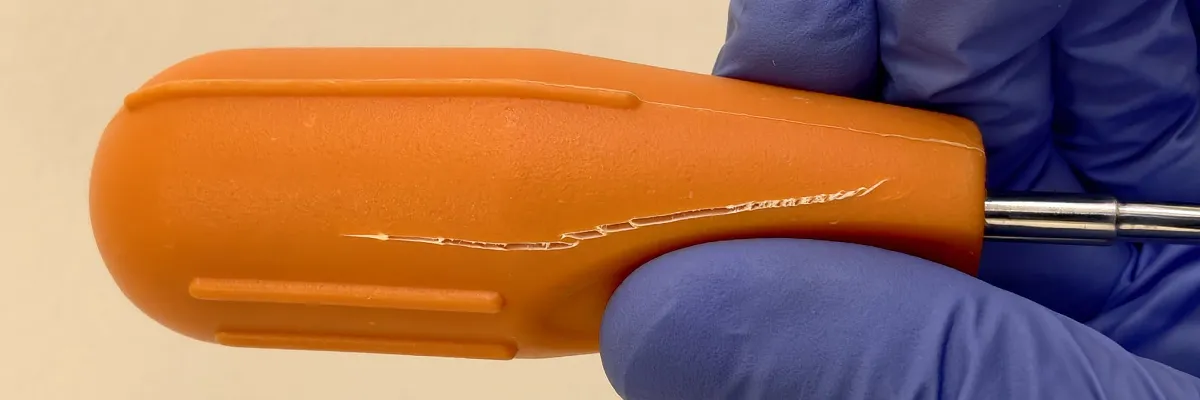
Luxators often have either a one-piece metal handle integrated with the blade or a separate plastic handle. Plastic handles have one drawback: they can chip or split. Even when the handle looks intact, repetitive luxation—especially on molars—can cause the handle to rotate around the blade, making the instrument useless. It’s not common, but it happens. That’s why we prefer one-piece instruments.
Sizes and selection
Luxators usually come in seven widths and two curvatures (straight and curved, sometimes marked “C”). Example: 5C = 5 mm wide, curved. Typical sizes: 2.0 mm; 2.5 mm; 3.0 mm; 3.5 mm; 4.0 mm; 4.5 mm; 5.0 mm.
- Anterior teeth/roots: use 2–3 mm.
- Posterior teeth: use 3–5 mm.
A 2 mm luxator is inconvenient to go around a second molar perimeter to sever the PDL—use 3 mm or larger. Dentists sometimes forget the purpose of a luxator (more often than you’d think) and start using it as an elevator, which can cause chipping or breakage. At Exitooth we provide luxators that are slender and sharp but can withstand some elevation. Still, be mindful of breakage risk—don’t try to elevate a molar with a thin 2 mm elevator‑luxator. Use it to sever the PDL with gentle elevation/wiggling. Always protect soft tissues from instrument slippage.
Elevators and roots
There are many elevator designs; root elevators are often left- and right-sided. In our experience, a curved Cryer elevator (Left-12mm, Right-12mm, Left-9mm, Right-9mm) works well for scooping roots due to its wheel‑and‑axle motion. Two common engagement strategies:
- Engage the root and try to elevate it out (scoop it out), or
- Engage intraradicular bone, break it, and then scoop the root out.
The latter carries risks: unpredictable fracture patterns, possible loss of interdental bone or cortical plates, and potential IAN injury.
Example technique (Exitooth approach for multirooted lower molars): If no coronal structure remains (sub‑bone level) and forceps won’t retrieve fragments, we use elevator‑luxators (2.0, 2.5, 3.0 mm) to loosen roots. Often this is enough. If fragments are mobile but stuck, we try a Cryer to scoop them. If that fails, we section—there’s a full article on sectioning.
Periotomes
Periotomes are often flexible so they can follow root curvature while cutting the PDL; some are more rigid. Using a periotome is more technique‑sensitive: the process is more delicate and usually longer than extraction with just an elevator or luxator. Depending on use, a periotome might be rendered useless after aggressive luxation. As noted, periotomes are ideal for immediate implant cases, especially in the anterior region where buccal bone is very thin. Only patient, precise clinicians should choose this route (pun intended).
Final Notes
- Match blade thickness to task: elevators = strength/lift, luxators = PDL severing + gentle lift, periotomes = most atraumatic PDL cutting.
- Use the correct size and curvature for the site.
- Prefer one-piece instruments for durability.
- Protect soft tissues and avoid forcing thin instruments into elevator roles.
- For immediate implants, consider periotome + luxator technique despite increased time and technique sensitivity.
Exitooth Team – From dentists to dentists.
From Dentists to Dentists – A Quick Note
These articles are written from real clinical experience and are meant to share practical insights—not replace formal training or clinical judgment.
Every case is different. What works in one situation may not apply in another. Always evaluate your patient, use evidence-based guidelines, and make your own informed decisions.
Extra: Content is for licensed dental professionals only and reflects personal clinical experience, not clinical guidelines.